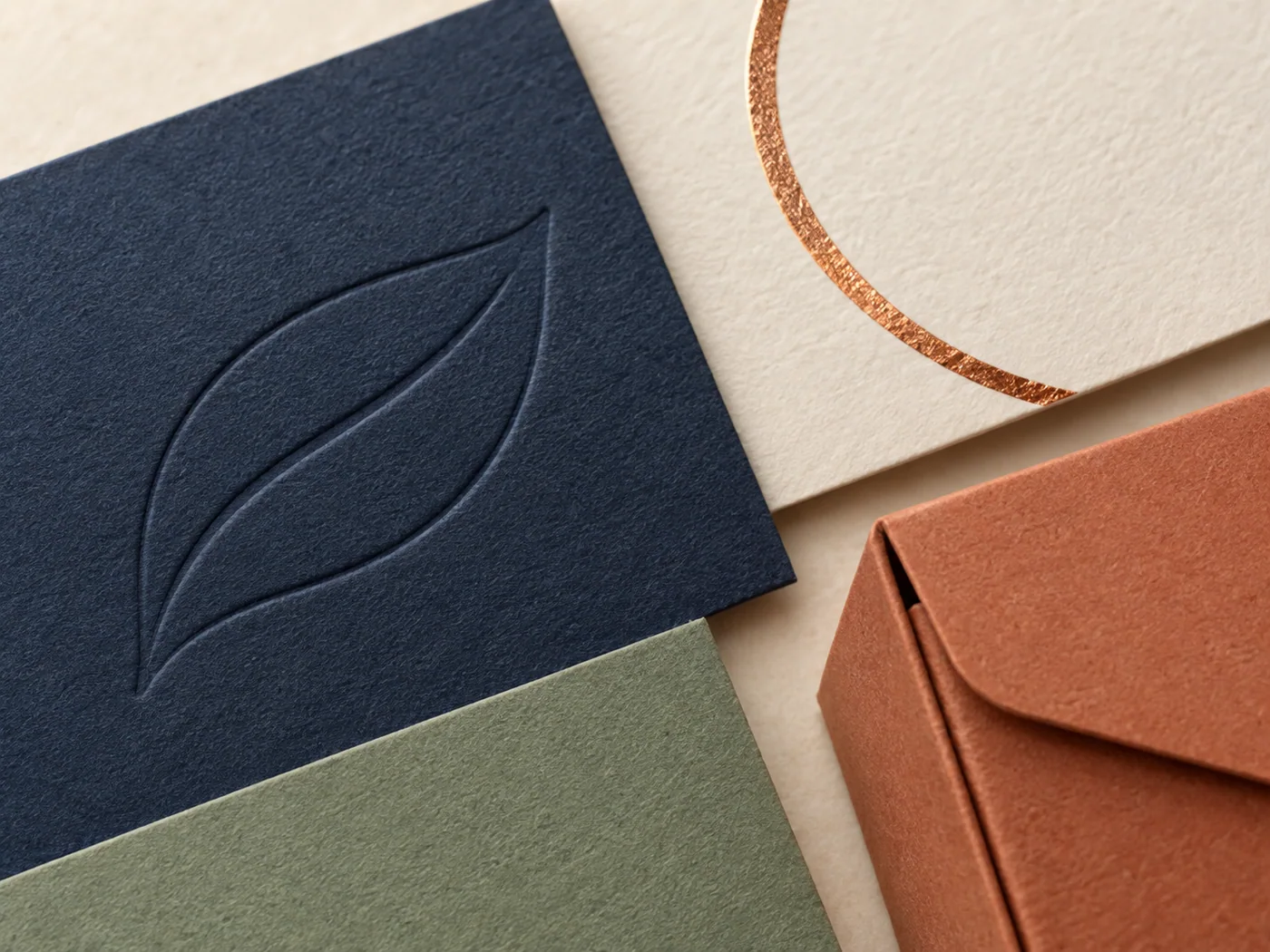
01Hot foil stamping
Use a metallic or coloured foil accent to give selected elements a distinct surface. Heat and pressure transfer the detail from a tooling die onto the substrate.
Where it fits
Gift-box logos, carton lettering and selected paper-bag accents.
Confirm with a sample
Review foil shade, paper texture, line thickness and registration on a sample. Tooling and large solid areas can affect the quotation.
Discuss this process ↗02Embossing & debossing
Raised or recessed impressions add a tactile dimension without relying on extra colour. A small, deliberate detail can give paper packaging a more considered feel.
Where it fits
Rigid-box wraps, folding-carton panels and premium printed covers.
Confirm with a sample
Paper thickness, grain, relief depth and nearby folds affect the result. Check fine details and the reverse of the impression before approval.
Discuss this process ↗03Spot UV & surface contrast
Selected glossy areas can contrast with a quieter background to highlight a pattern or illustration. Textured coating effects are a separate process choice to discuss.
Where it fits
Retail cartons, presentation boxes and catalogue covers.
Confirm with a sample
Supply a separate finishing layer and review alignment, adhesion and fold areas. Ask for a relevant sample rather than assuming every UV effect is identical.
Discuss this process ↗04Matte & gloss lamination
An overall surface treatment changes reflection and handling. Compare a low-glare matte direction with a more reflective gloss surface as part of the complete design.
Where it fits
Printed paper bags, carton faces, booklets and presentation packaging.
Confirm with a sample
Check colour shift, scuffing, crease behaviour and suitability for later finishing. Disposal and recycling claims require evidence for the complete finished construction.
Discuss this process ↗05Soft-touch surfaces
A soft-touch coating or film offers a different handling experience from standard matte. Pair it with restrained graphics when the tactile surface is the main design detail.
Where it fits
Beauty cartons, gift-box wraps and selected brochure covers.
Confirm with a sample
Compare fingerprinting, rubbing and compatibility with foil or other finishes. Specify the actual coating or film rather than relying only on the name.
Discuss this process ↗06Screen printing
Ink is applied through a prepared mesh onto selected areas. It can offer a distinctive graphic treatment when the substrate, ink and production route are suitable.
Where it fits
Specialty-paper details, graphic accents and selected packaging surfaces.
Confirm with a sample
Confirm the substrate, ink adhesion, colour coverage and fine-detail limits. Suitability for one surface does not establish suitability for all materials.
Discuss this process ↗07Cold foil effects
A cold-transfer process can introduce reflective metallic elements as part of a compatible print workflow. Overprinting may be used to explore coloured metallic appearances.
Where it fits
Selected label designs and printed carton graphics.
Confirm with a sample
Confirm process availability, substrate smoothness and overprint expectations. This is not interchangeable with hot foil stamping; agree a representative reference first.
Discuss this process ↗08Die-cutting, creasing & folding
Cut lines and planned folds turn a printed sheet into a usable structure. Tabs, openings and assembly details should follow the product and the packing method.
Where it fits
Folding cartons, mailers, printed inserts and custom windows.
Confirm with a sample
Review the dieline with an assembled sample. Check fit, crease position and board behaviour; a decorative opening may change protection or strength.
Discuss this process ↗09Offset printing
A sheet-fed print direction for paper packaging and business literature. Discuss image reproduction and colour expectations together with the selected paper and finishing route.
Where it fits
Folding cartons, bag graphics, brochures, catalogues and instructions.
Confirm with a sample
Check CMYK or spot-colour setup, bleed and proofing references. Screens and different papers can show colour differently, so agree how final appearance will be approved.
Discuss this process ↗10Gravure printing & flexible lamination
Printed film and laminated material layers can be developed as part of a flexible-packaging structure. Review graphics alongside the layers, sealing area and intended contents.
Where it fits
Food pouches, liquid formats and other specified flexible packs.
Confirm with a sample
Discuss tooling, quantity, barrier needs, curing and sealing requirements. Food-contact or chemical compatibility must be confirmed for the specific material and application.
Discuss this process ↗