By Victoria Qiu · · 9 min read
A practical way to start buying custom paper bags is to define five things before you contact any supplier: what the bag will carry, its finished width × depth × height, the packed weight, your quantity, and whether your artwork is print-ready. Handle style and paper grade follow from those answers. Confirm both with a physical sample before approving production.
A branded paper bag is one of the few packaging items a customer carries through a store, into a car, and onto a kitchen counter. It has to hold up physically, look right in the customer’s hand, and represent your brand long after the sale. This guide gives retail buyers a practical checklist for specifying, sampling, and approving custom paper bags without leaving critical details to guesswork.
Start with the Bag’s Job, Not the Artwork
It is easy to focus on logo placement before deciding how much weight a bag must hold or how it will be carried. Start with its use and load, then develop the artwork.
The basic logic of retail paper bags is to define the product load, dimensions, and desired handle style before selecting paper, reinforcement, and print details. Every later decision — material, handle attachment, base build — depends on those three inputs.
Write a one-paragraph brief that covers:
- What goes in the bag. Apparel and soft goods behave differently from candles, jars, books, or takeaway food containers.
- How much it weighs when packed. Not the bag’s capacity — the realistic filled weight, including any tissue, inserts, or a gift box.
- How far it travels. A bag handed over at a checkout counter has a different life than one carried through a mall, a hotel lobby, or a trade show floor.
- How it is presented. Handed to a customer, placed on a shelf, included in a shipped order, or used as a gift bag.
Formats Worth Discussing
Paper bag construction is not one product. Before you request pricing, identify which format you actually need:
- Retail carry bags for everyday purchases
- Boutique shopping bags for higher-value or gift-oriented retail
- Gift bags, where presentation and the intended contents both inform the construction
- Takeaway paper bags for food and beverage applications
These formats can differ in paper grade, base construction, and handle treatment. If your brand needs more than one, ask for each to be quoted separately rather than assuming a single specification will serve all of them.
The Specification Checklist
Use this list as the working document you send to a supplier. Complete every line you can; mark the rest as open questions.
Dimensions and Capacity
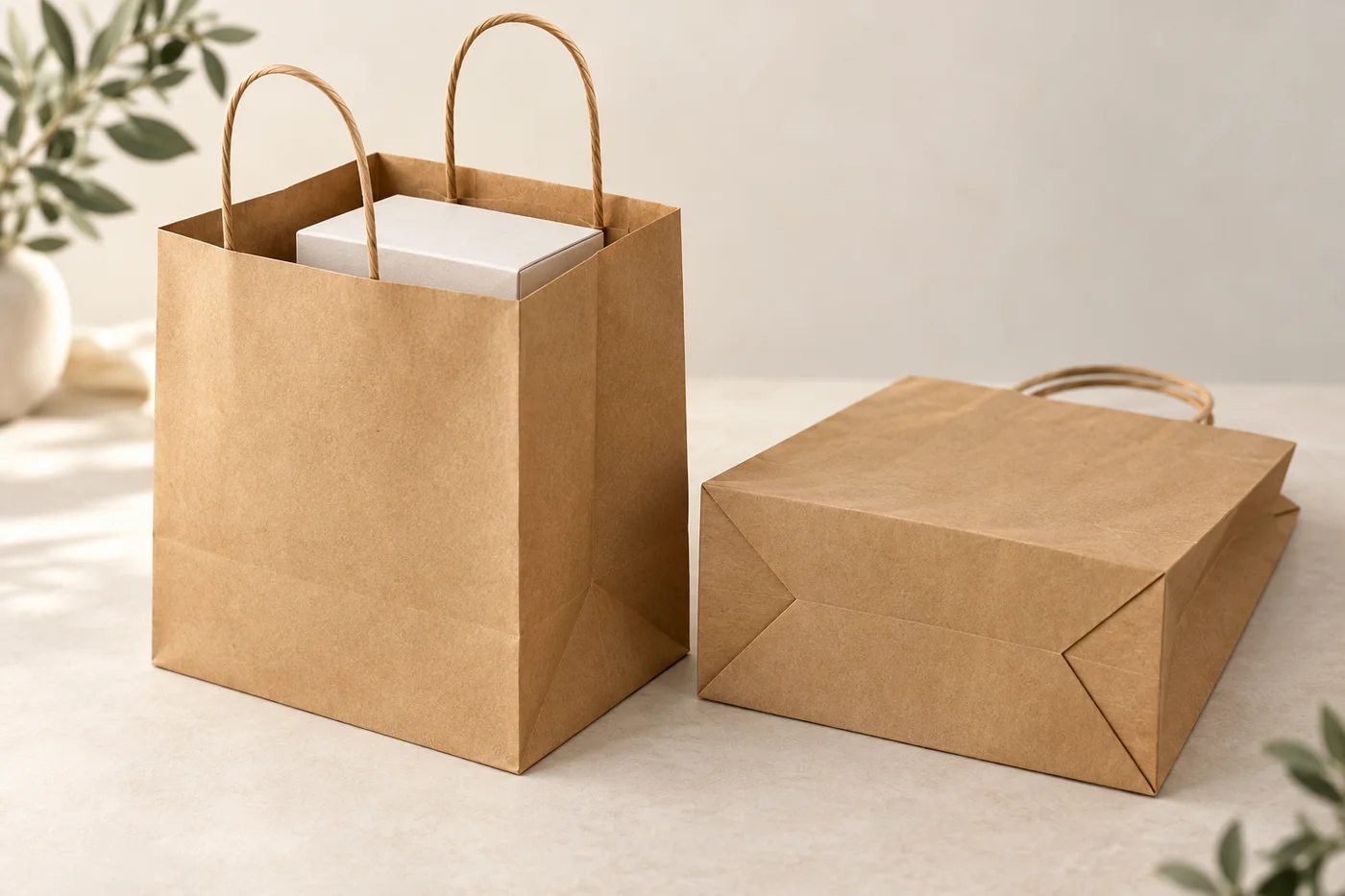
- Finished bag width × depth × height, in inches or millimeters, stated clearly
- Whether dimensions are inside or outside measurements
- Gusset (side depth) required for boxed or bulky items
- Packed weight the bag must carry
- Whether the bag needs to stand upright unaided on a counter or shelf
Paper and Finish
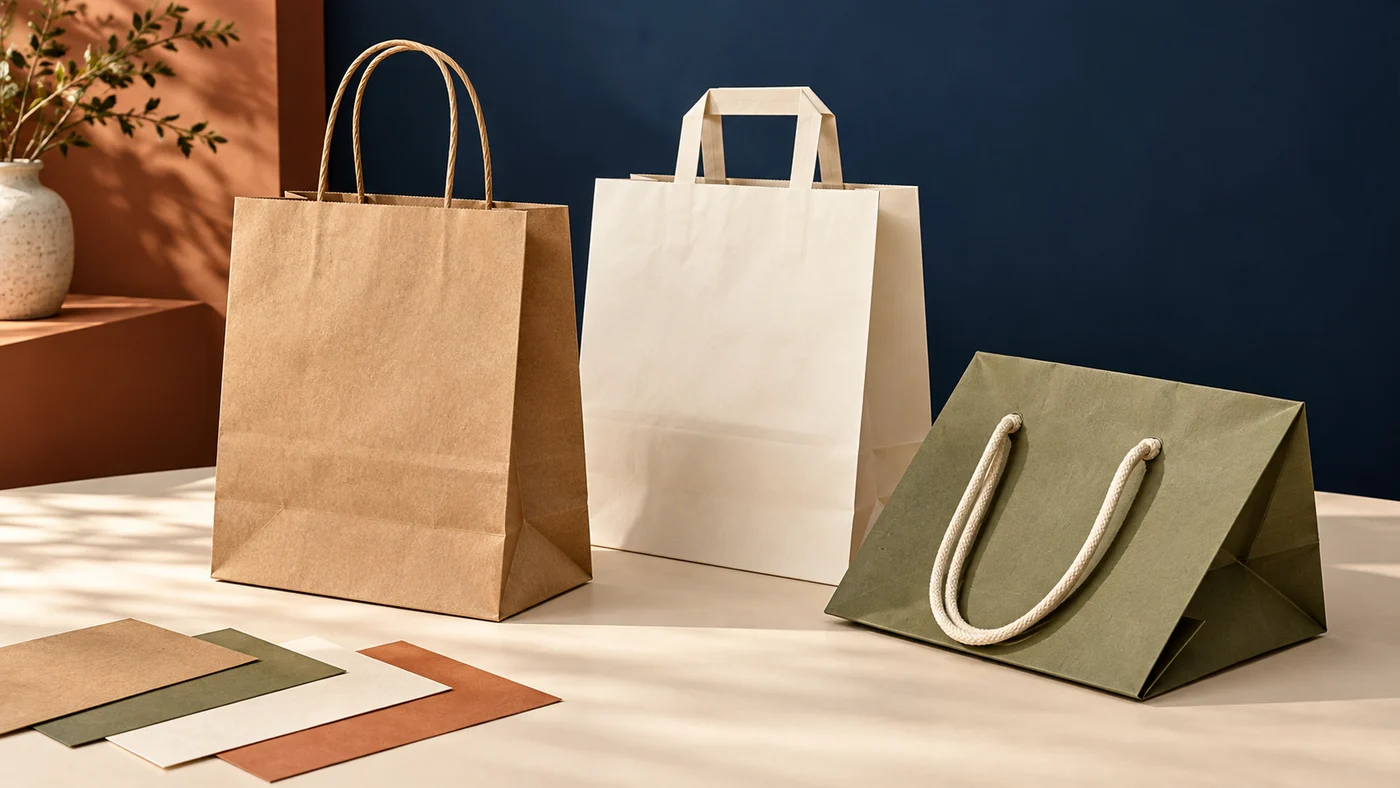
- Material direction: kraft paper, white paper, or coated paper, selected based on load and finish requirements
- Desired surface look: natural kraft, bright white, matte, or coated for sharper print
- Print method and number of colors
- Ink coverage — full-bleed designs and large solid areas are a different production conversation than a single-color logo
- Interior printing, if the bag opening will reveal an inside surface
Handles and Structural Details
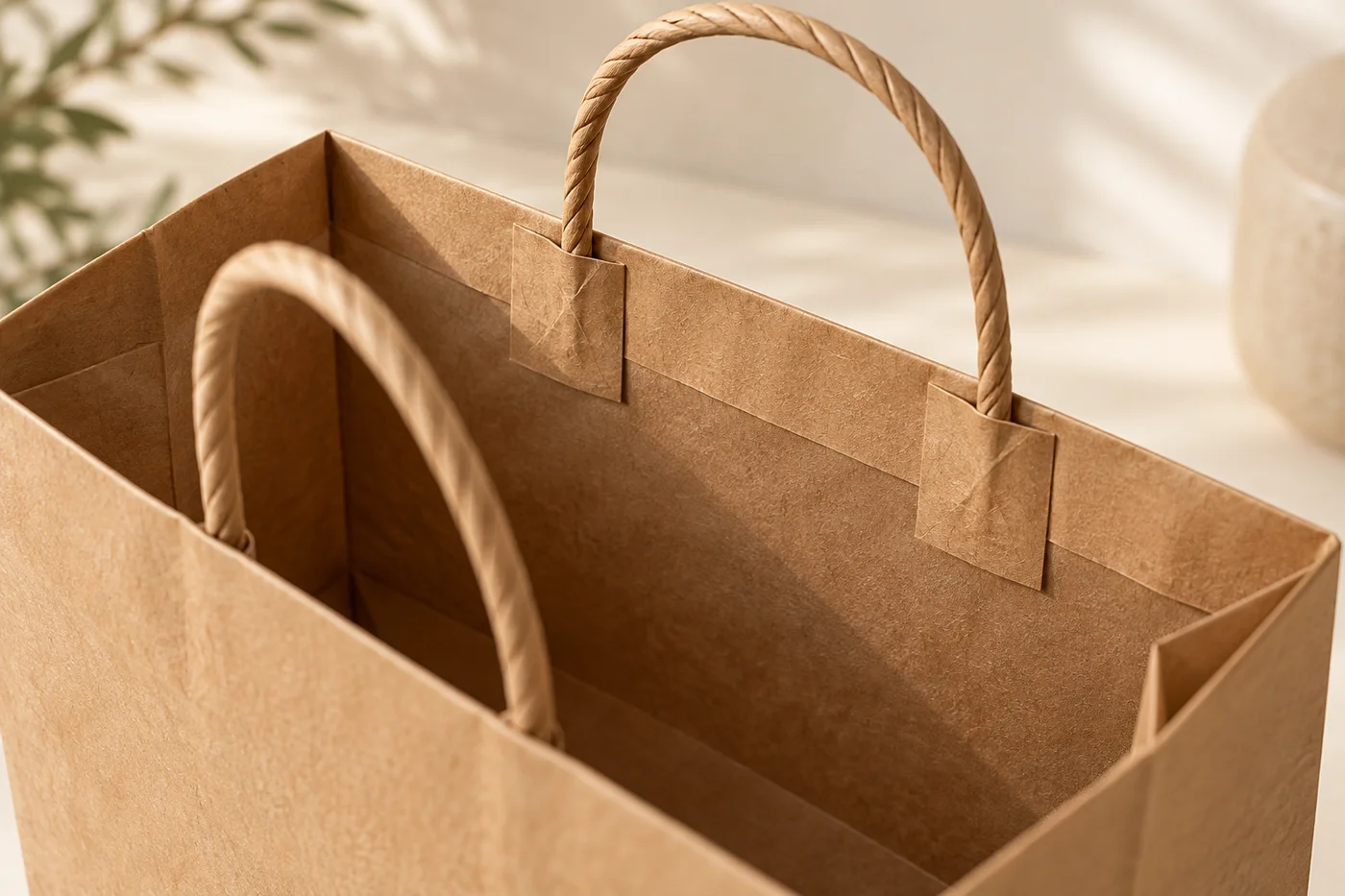
- Handle direction: paper handles, cord, or ribbon
- Handle attachment method and reinforcement at the attachment points
- Top fold style and depth
- Base reinforcement for heavier loads
- Any window, insert, or divider requirements
Order and Artwork Details
- Quantity
- Artwork status: print-ready files or artwork still in development
- Destination and delivery requirements
- Any compliance or labeling needs for your category
The information needed for a quote is straightforward: bag width × depth × height, packed weight, quantity, and artwork. If you can supply all four, you will get a far more useful response than a generic price request.
Paper Selection: A Decision Framework
Paper choice follows load and finish. There is no universally “best” paper — only the right match for the bag’s job.
| Buying priority | Paper direction to discuss | What to confirm |
|---|---|---|
| Natural, unbleached look for boutique or specialty retail | Kraft paper | Whether the grade suits your packed weight and how artwork reads on the darker surface |
| Clean, bright presentation for apparel and cosmetics | White paper | Opacity and how fine detail prints at your logo size |
| Sharper graphics and a smoother surface | Coated paper | Whether the coating suits your finish and handling expectations |
| Heavier or denser contents | Grade selected for load | Base reinforcement and handle attachment strength |
Treat this table as a starting point for a conversation, not a specification. Final paper weight, grade, and construction must be confirmed against your actual product load, and the supplier should be willing to validate the combination with a sample.
Handles Are a Load Decision
Handle attachments, paper, folds, and the base all affect how a bag carries its load. A tear at an attachment point needs investigation against the approved specification and sample; its cause should not be assumed.
When reviewing handle options, ask:
- What is the handle made of? Paper, cord, and ribbon each behave differently under load and against the hand.
- How is it attached? The attachment method and any reinforcement at the anchor points matter more than the handle material alone.
- Is it comfortable at your packed weight? Thin cord on a heavy bag creates a pressure point; a paper handle on a light gift bag may be perfectly adequate.
- Does the top fold support the handle? Top fold depth and construction work together with handle choice.
For heavier loads, plan to discuss base reinforcement at the same time. The base carries the weight; the handle transmits it.
Sample and Approval Workflow
A digital mock-up shows color and layout. It does not show how a bag behaves in a customer’s hand. Build a physical sample step into your timeline.
- Brief the supplier with dimensions, packed weight, quantity, handle direction, and artwork status.
- Confirm the specification in writing before sampling — paper, handle type, print method, and dimensions.
- Request a sample and evaluate it with your real product inside, not an estimate of the weight.
- Validate handle construction and load expectations using that sample. Carry it, set it down repeatedly, and check the base and handle anchors.
- Approve artwork separately from structural approval. A signed print proof and a signed structure sample are two different approvals.
- Keep a reference sample from the approved run so future reorders can be checked against it.
If you need testing documentation for your category or sales channel, request it explicitly and review what is actually provided. A document on a checklist is not proof that a test has been performed or that an approval exists — ask for records specific to your order and understand their scope.
Questions to Ask Before You Approve
- Are the quoted dimensions inside or outside measurements?
- Which paper grade was specified, and was it selected against my packed weight?
- What handle construction is being used, and how is it reinforced?
- Can I see a physical sample with my artwork before the full run?
- What does the artwork proof cover, and what does it not cover?
- What is the reorder process, and will the same specification be held?
- Are there any labeling or material documentation requirements for my destination market?
Ask these in writing. Written answers create a record you can compare against the delivered order.
Buyer FAQs
How many dimensions do I need to provide for a quote? Three: width, depth, and height. Add packed weight, quantity, and artwork status, and you have everything a supplier needs to respond usefully.
Should I choose kraft, white, or coated paper? It depends on load and finish. Kraft supports a natural look, white gives a clean bright surface, and coated paper supports sharper graphics. Confirm the grade against your packed weight rather than choosing on appearance alone.
Can I approve artwork without ordering a physical sample? You can, but artwork approval and structural approval are separate decisions. A print proof will not tell you whether the handle and base suit your product’s weight.
What if my artwork isn’t finished yet? Say so up front. Suppliers can often quote structure and quantity while artwork is in development, but production timelines depend on receiving print-ready files.
How do I confirm the bag will hold my product? Specify the packed weight, discuss handle and base reinforcement, and test a physical sample with the real contents. Do not rely on a capacity estimate.
Next Step
A good paper bag order starts with a clear brief, not a design file. Gather your dimensions, packed weight, quantity, artwork status, destination, and application requirements, then send them for a written quote and sample discussion.
Visit the custom paper bags product page to review format and material directions, and request a quote with your project details. If email is easier, send your specification to info@xinxinprint.com. Ask specifically for artwork approval steps, samples, and any testing documents relevant to your order.
General guidance only. Discuss the product-specific materials, process, market requirements and testing before approving production.