By Victoria Qiu · · 9 min read
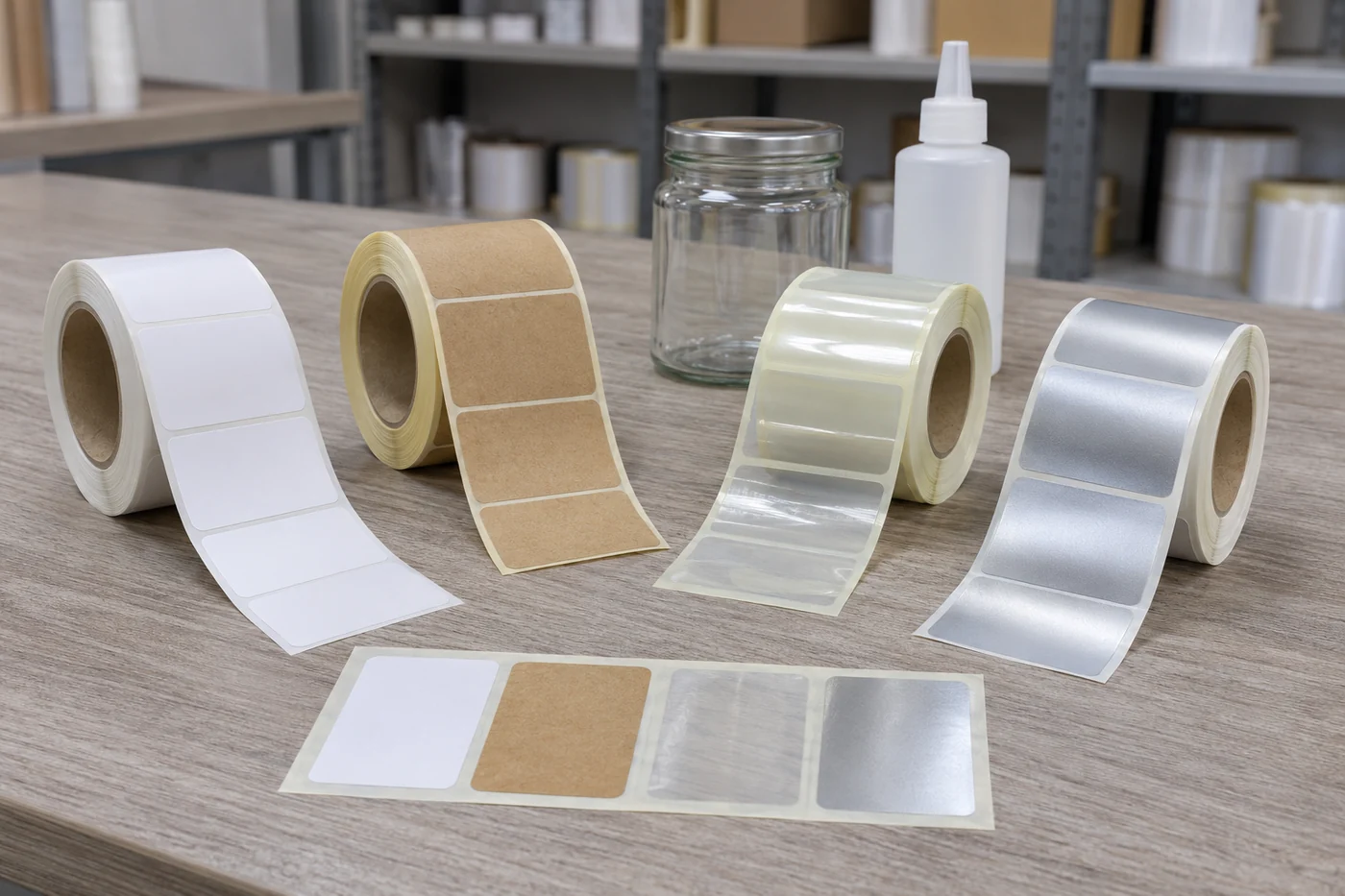
Self-adhesive labels appear on food jars, retail products, cosmetics, appliances and shipping packs. Choosing one involves more than selecting a white, clear or metallic surface. Start with the face material, then match the adhesive, printing method and protective finish to the container and its use.
This guide explains 18 common label options from a practical purchasing perspective. They are not 18 mutually exclusive raw materials: some names describe paper or film, while others describe an adhesive function, printing process or finish.
Paper and Film: The Two Main Face-Material Families
A pressure-sensitive label normally combines a printable face material, an adhesive and a release liner. The liner is removed during application. Paper and film describe the face material, not the performance of the complete label.
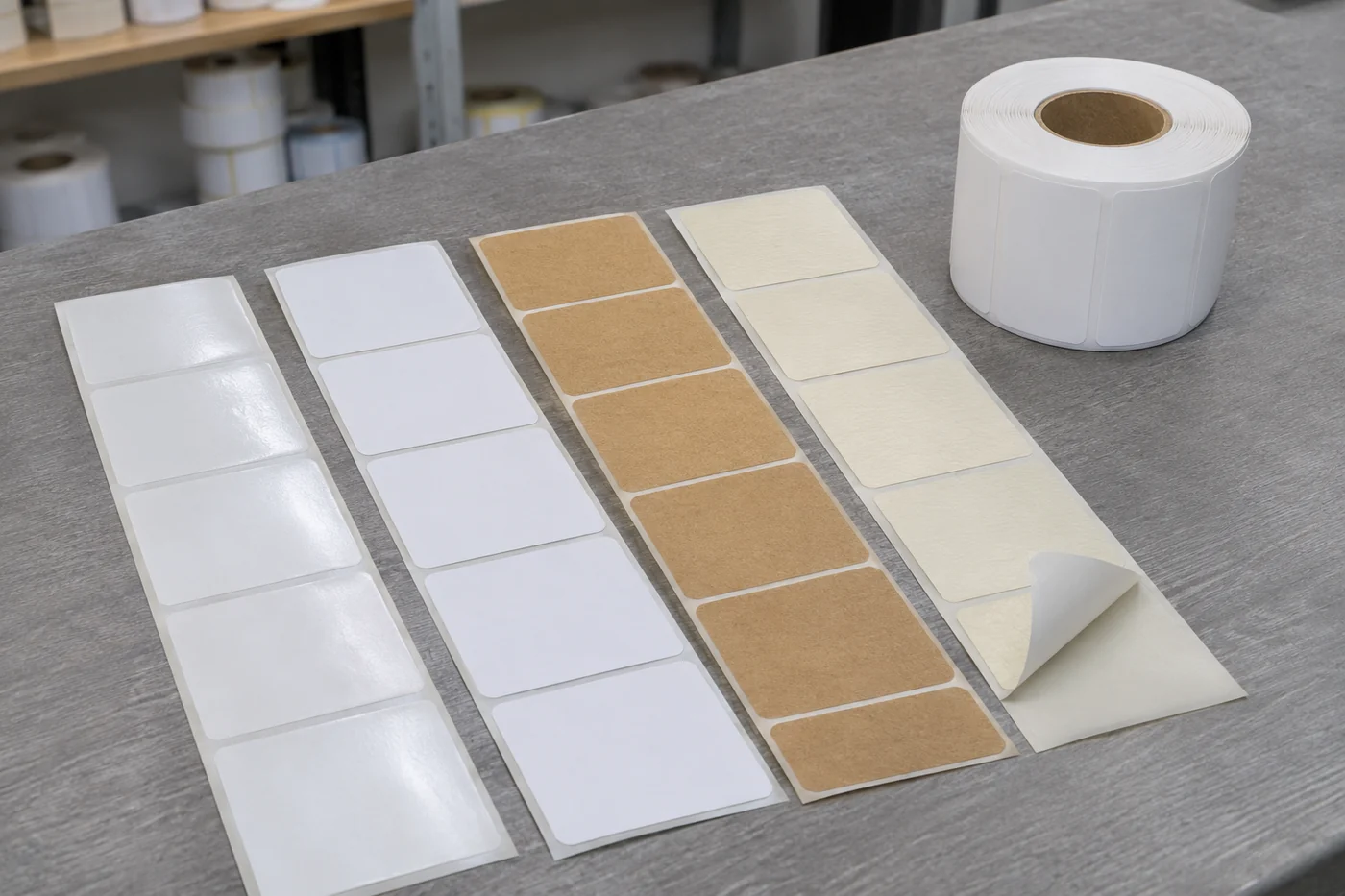
Paper labels include uncoated, coated, cast-coated, kraft and textured grades. They offer different writing surfaces, print effects and tactile finishes. For wet, oily or repeatedly handled products, specify a suitable paper construction and protection instead of assuming every paper label will survive the same conditions.
Film labels commonly use PE, PP or PET. Depending on the grade, they can provide flexibility, clarity or durability for personal care, household and industrial applications. White, clear, gloss and matte are appearance options; they do not identify the polymer. UPM’s film label material guide explains these material families and application considerations.
Specialty options also include synthetic paper, PC, PS and engineered security materials. Fabric labels and Tyvek should not be classified as ordinary paper: DuPont identifies Tyvek as an HDPE-fiber material.
10 Paper-Related Label Options
The first nine entries cover paper faces or paper printing options. The tenth describes adhesive behavior and can be combined with either paper or film.
| Option | Characteristics and specification points | Typical applications |
|---|---|---|
| 1. Writing or uncoated paper | A writable surface for simple information and variable data. Select a grade specifically approved for the intended laser or inkjet printer; compatibility is not universal. | Retail price labels, tea packaging, handwritten identification and office labels. |
| 2. Coated art paper | A smooth surface for detailed color printing. Unprotected paper remains vulnerable to moisture, oil and tearing. Gloss, matte or holographic lamination and foil decoration may be considered with a compatible construction. | Food and beverage packaging, personal care, stationery and general product labels. |
| 3. Cast-coated paper | Often called mirror-coated paper, this grade offers a high-gloss surface for decorative multicolor work. Gloss alone does not make the finished label waterproof. | Premium product presentation on beverages, food packs, cosmetics and household goods. |
| 4. Kraft paper | The natural brown base influences ink color. Simple black or restrained artwork can work well with its appearance. Confirm opacity, coating and any foil or UV-printing requirements on a sample. | Wine, tea, artisan goods, gifts and vintage-style branding. |
| 5. Aluminum-foil or foil-laminated paper | A metallic effect may come from actual foil or another coated construction. Confirm the supporting paper or film, adhesive and protective layer. Temperature and humidity performance are grade-specific, not unlimited. | Decorative labels for premium food, beverages, stationery and other consumer products. |
| 6. Destructible security paper | A specified fragile face can break when removal is attempted. Performance depends on the adhesive and application surface. This is a tamper-evident feature, not proof that counterfeiting is impossible. | Warranty seals and opening indicators on electronics, cartons and selected consumer products. |
| 7. Textured or creped paper | Texture can add a tactile character. Decorative textured label paper and masking-paper grades serve different purposes. Do not infer easy removal, water resistance or high-temperature performance from texture alone. | Wine, tea and cosmetic labels where a textured finish is part of the design. |
| 8. Direct thermal paper | A heat-sensitive coating forms the image without a ribbon. Choose the coating and expected image life for the exposure conditions; excessive heat or light can affect readability. | Retail pricing, weighing-scale labels, shipping and other relatively short-life information. |
| 9. Thermal-transfer paper | Printing uses a ribbon, which must suit the paper coating and required image durability. This is a printing-compatible construction, not a claim that the label is microwave-safe. | Inventory, logistics, product identification and variable-information labels. |
| 10. Removable or wash-off constructions | These are adhesive functions, not paper types. Removable labels are designed for peeling; wash-off labels release under specified washing conditions. Request separate requirements and trials for each. | Temporary appliance or tableware labels, promotions and specified returnable-container systems. |
Zebra’s thermal printing explanation distinguishes direct thermal from ribbon-based thermal transfer. For removal behavior, compare HERMA’s removable adhesive guidance with UPM’s wash-off adhesive guidance. The container surface, washing process and complete printed construction matter.
8 Film Label Materials and Finishes
The following list combines polymer families with shrink formats and decorative finishes. A gold, silver or holographic appearance does not, by itself, identify the underlying film.
| Option | Characteristics and specification points | Typical applications |
|---|---|---|
| 1. PE: polyethylene | A flexible face-material option for containers that deform during use. Clear, glossy white and matte-white grades are available. Match the adhesive and printing system to squeezing, moisture and the product contents. | Toiletries, cosmetics and squeeze bottles. |
| 2. PP: polypropylene | Available in white, clear and different surface finishes. Often selected for product-label appearance and moisture exposure. Thermal-transfer printing requires a suitable printable grade and matching ribbon. | Cosmetics, toiletries, food containers and household products. |
| 3. PET: polyester | A candidate for durable identification, including some demanding temperature or chemical environments. Select the exact face, adhesive, ink and protective layer from technical data and application trials. | Electronics, appliances, equipment and products needing durable information. |
| 4. PVC: polyvinyl chloride | A conformable film offered in several colors and finishes. Do not treat every PVC construction as a high-temperature label. Confirm the specified application and service-temperature limits. | Selected appliance, hardware, personal-care and general industrial labels. |
| 5. PVC shrink film | A heat-shrink sleeve or wrap format used in some battery and container applications. Ordinary shrink sleeves are not the same construction as pressure-sensitive adhesive labels. Confirm the format before ordering. | Specified battery wraps and shrink-sleeve projects. |
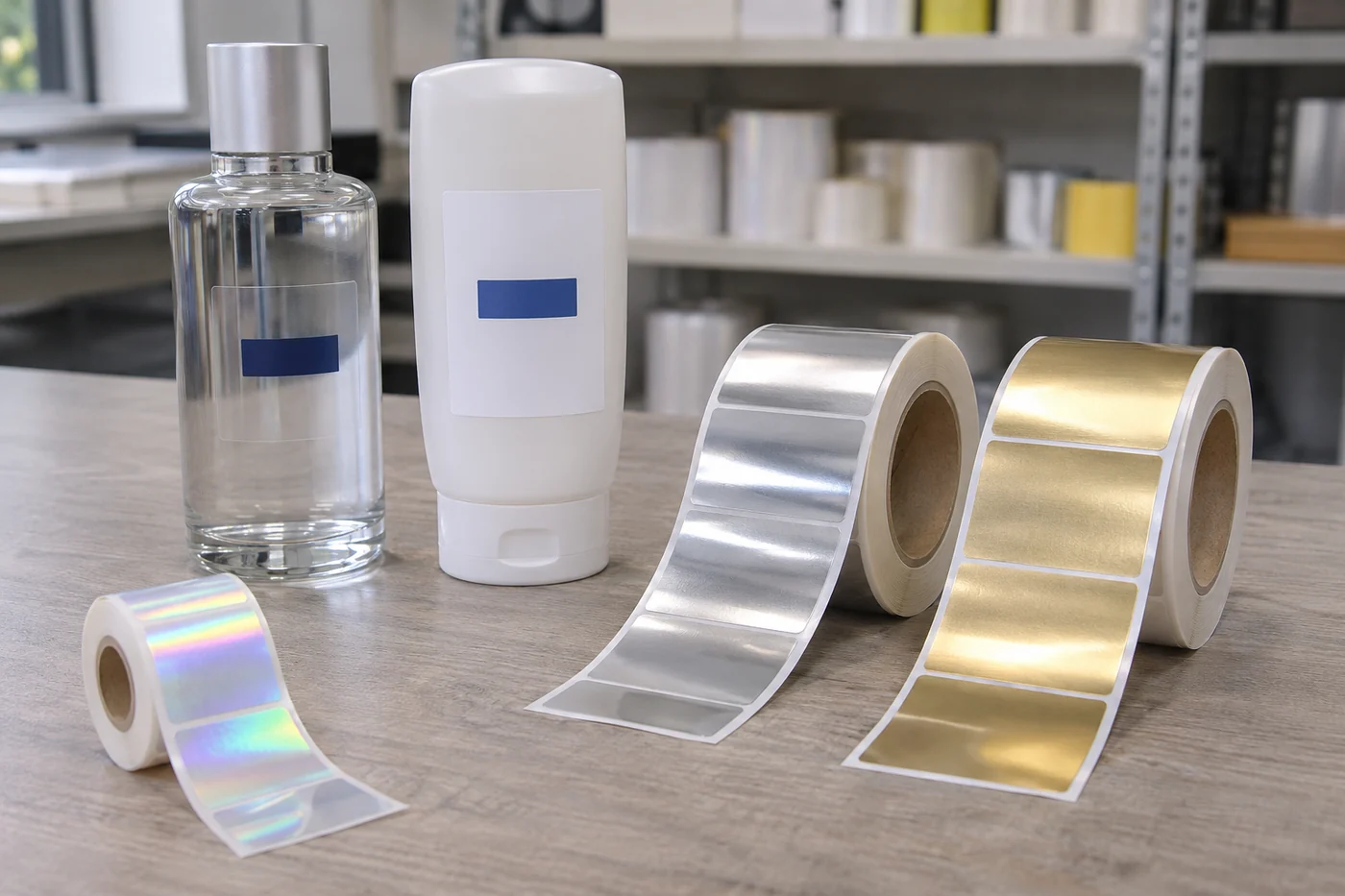
| 6. Holographic film | A diffractive surface changes appearance with viewing angle and light. It can support decorative or security design, but the visual effect alone does not establish authentication strength or environmental benefits. | Premium beverages, cosmetics, electronics and promotional packaging. |
| 7. Gloss gold or silver film | A bright metallic finish that may be produced on different supporting films. Ask for the base polymer, print-receptive coating and resistance requirements, rather than ordering by color alone. | Decorative product labels and specified equipment or electronics identification. |
| 8. Matte gold or silver film | A lower-gloss metallic finish for a restrained appearance. Opacity, scratch resistance, chemical resistance and outdoor life depend on the actual material construction. | Appliances, machinery, electronics and premium consumer packaging. |
For industrial use, a material name is only the starting point. Avery Dennison’s durable-label material data lists different service limits for different constructions. Use current data for the grade being quoted instead of transferring a rating from another product.
A Practical Label Specification Checklist
Give the supplier enough information to evaluate the complete label:
- Container: glass, metal, paperboard, PE, PP or another surface; include curvature, texture and whether the container squeezes.
- Label format: dimensions, shape, corner radius, roll or sheet delivery, core size and winding direction where relevant.
- Application conditions: surface cleanliness, moisture and temperature when the label is applied.
- Service conditions: refrigeration, water, oil, cleaning agents, sunlight, handling and the required life of the printed information.
- Removal behavior: permanent, peel-removable, destructible or wash-off, with the actual removal or wash conditions.
- Printing and finishing: artwork, variable data, printer model, ribbon if used, white ink, lamination and metallic effects.
- Acceptance: approve samples on the real container after an agreed dwell time and representative exposure. Record lifting, residue, tearing, print rub and readability criteria.
Food, medicine and cosmetics projects may have additional market-specific requirements. Ask for documentation for the intended application; a generic face-material description does not establish food-contact suitability, required labeling compliance or recyclability.
Common Buyer Questions
Are film labels automatically waterproof?
No. A film face may tolerate moisture while the printed image, edges or adhesive still fail. Specify the complete label and test the intended conditions.
Can a paper label be removed without residue?
That depends on the adhesive, surface, dwell time and removal conditions. Paper describes the face, while removable describes the intended adhesive behavior.
Which is better for a squeeze bottle: PE, PP or PET?
Begin with the bottle’s flexibility and shape. PE is one flexible option, but the final choice should follow trials of the complete label on the actual container. There is no universal best material for every bottle.
Discuss Your Label Printing Brief
Commercial information from XINXIN
Send the container details, label dimensions, artwork and expected exposure through our contact page or email info@xinxinprint.com. Our instructions, labels and printed inserts page outlines the information to prepare for a project discussion.
Editorial Scope
Adapted into English from the supplied Chinese material overview, with technical terminology and performance statements clarified. Manufacturer references were checked on 3 November 2026. They explain material selection principles and selected supplier constructions; they do not certify XINXIN products or establish a universal list of 18 label materials. Images are AI-generated concepts, not laboratory results or photographs of a named customer’s products.
General guidance only. Discuss the product-specific materials, process, market requirements and testing before approving production.